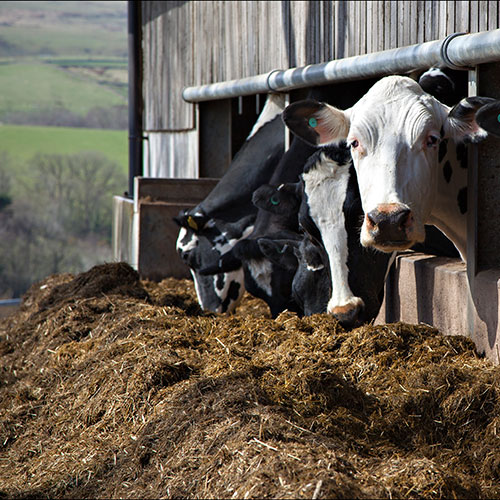
Advanced Robot’s experience means they are always challenging me to get the best out of the cows, they maintain the herd’s health status whilst also improving performance.
Optimising Milk Yields Through Technology
Eoghan Mullery from Advanced Ruminant Nutrition explains why producers face challenges when it comes to sustainability and why technology is just part of the picture. First published in British Dairying

Over the past decade, technology in dairying has advanced rapidly, driving significant improvements in productivity and efficiency. At the same time, producers face increasing pressure to operate more sustainably. Modern systems generate vast amounts of on-farm data, many farmers struggle to turn these insights into practical, day-to-day decisions. When technology is not fully understood or effectively integrated into daily operations, its potential to support sustainability goals can be lost, leaving sophisticated systems as costly investments with little real return.
“Successful integration demands a clear strategy - not just to gather data, but to act on it consistently and effectively,” notes Eoghan.
Automated milking systems (AMS) offer a clear example of both the promise and the challenge of farm data. A single robot can generate more information than most conventional dairies, capturing daily data from individual cows on milking performance, udder health, and animal behaviour. According to Eoghan, if used correctly, this depth of data can be transformative, however, he is clear to point out - only if it is integrated into the right manage-ment approach. Eoghan and his team have worked with robotic farms for more than a dec-ade, accumulating a substantial data-set that now feeds into what they call a Robotic Intelligence System. For Eoghan, the principle is simple: data is only as valuable as the people interpreting it. “Our system combines client data pulled directly from the robot with our own extensive datasets,” he explains.
“But the real strength lies in the team behind it - a deliberately diverse group that includes vets, former herd managers, foot trimmers and other specialists.” The result, he says, is improved efficiency, optimised milk yields and stronger long-term sustainability for the dairy producer. Beyond day-to-day decision-making, the data is also used to benchmark performance within a herd as well as outside, to help identify performance gaps. These gaps are identified by real time data, so they aren’t predictions or estimates which Mr Mullery stresses make this data very powerful and measurable so that economic gains can be achieved hand in hand with better sustainability. Making better use of data from technology already embedded on dairy farms is something producers can act on today.
When applied effectively, these insights can improve sustainability through gains in feed efficiency and cost control, while crucially delivering real economic returns for the business. In an increasingly tight margin environment, that combination will be a defining factor moving forward. Eoghan highlights a practical example of how on-farm data is increasingly being used as a decision-support tool with his clients. “Monthly farm visits have evolved significantly over the time I’ve spent feeding cows,” he explains. “The fundamentals haven’t changed, producing healthy cows, high-quality forages and best practice remain the foundation of any good dairy operation. But as more technology has been integrated into farms, the knowledge and experience needed to interpret and use that data as a true decision-support system has become crucial.”
Craig Sloan of Shawsmuir Farm is one such client benefiting from this support system, “For us, yield persistency is where high production really becomes efficient production. The nutrition and management decisions we make now, right down to what we focus on during routine visits, are all driven by understanding the data. Within our own herd, we can track yield persistency over time and see exactly what’s working and what’s not. But just as importantly, we can benchmark ourselves against other herds that may be performing better in certain areas. That’s what challenges us and that’s what sets the next target.”
Reducing soya inclusion is a key area for dairy farms to address sustainability targets. Greg Leishman, Ruminant Nutritionist at ARN, has worked closely with Mark Stewart at Smallholmburn Farm to address this issue while also increasing milk yield. By combining technology, data, and expert nutritional insight, Greg helped the farm better understand the balance of amino acids within the ration. This allowed protein levels to be reduced while creating more space in the rumen to increase starch inclusion.
“Despite the challenge of reducing soya, costs have decreased. The key has been the space created for more energy; using amino acids has helped to improve performance,” explains Greg. Detailed forage analysis, feed efficiency data, and the use of rationing software, alongside Greg’s extensive experience, have delivered tangible results. Milk production has increased, with the herd now averaging 44 litres per cow per day. Importantly, the system enables greater use of homegrown forage, supporting long-term sustainability by producing more milk from forage and reducing reliance on imported soya.
“While technology and data play a large part in achieving high performance levels, it’s the team approach that really utilises the data. We have monthly management meetings with the full farm team, including the herd manager, vet, nutritionist, and foot trimmer, to monitor key performance indicators (KPIs). Understanding the bigger picture allowed Greg to see the wider impact of any nutritional decisions in driving performance,” explains Mark Stewart, Smallholmeburn Farm. “If dairy farmers are expected to become more sustainable, we must build confidence that sustainability does not need to mean higher costs or reduced margins. With the right approach, stronger margins are achievable. It begins with a joined-up strategy at farm level,” notes Eoghan.
〈 BACK