We’ve been happy to have Advanced Robot join our team, we are really starting to see the benefits of their experience. We’ve achieved the target of 2.8 visit average whilst grazing with the ABC system.
Driving milk quality improvements
For one dairy a revised approach to cow environment, forage quality and precision feeding has strengthened output and milk value. British Dairying finds out more.

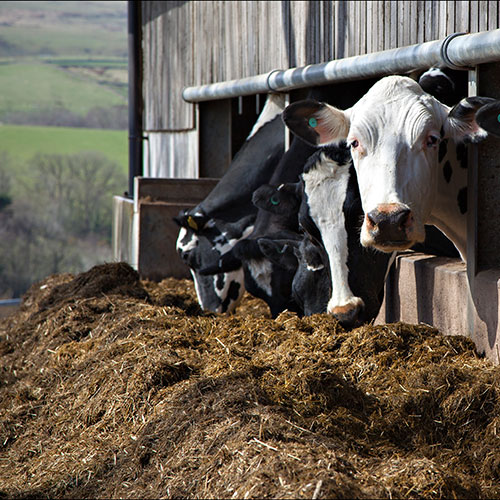
Gary Swires farms with his brother Steven, Gary’s sons Jack and Jordan, and Steven’s son Daniel at High Moor Farm in Harrogate. The Yorkshire-based 324-ha farm is home to 1,200 head of cattle, with a focus on 425 Holstein Friesians. Of these, 370 are milking cows producing over 34 litres/cow per day at 4.85% butterfat and 3.78% protein.
Over the past few years, the team have placed an emphasis on driving milk quality to maximise their milk contract by focusing on key areas, and continual improvements which have had a big impact. At the same time, they have also increased overall milk volume, a testament to the joined-up approach taken across the business.
|
|
December 2023 |
January 2026 |
% Improvement |
|
Milk yield |
28kg |
34kg |
21.4% |
|
Butterfat |
4.58% |
4.85% |
5.9% |
|
Protein |
3.55% |
3.78% |
6.5% |
The herd has been bred specifically to produce more milk butterfat and protein, with genomic testing making them more agile to market demands. “Breeding, nutrition and the temperature in the shed have all had a positive impact on milk quality,” explains Gary.
The family work closely with Richard Bainbridge at Advanced Ruminant Nutrition, who plays a key role in balancing diets around homegrown forage. Richard routinely monitors milk quality and dung consistency, along with key indicators like milk urea. His primary focus is on optimising production, feed efficiency, and overall margin.
Historically, the farm relied heavily on soya alongside maize to drive energy in the ration. Several years ago, however, they made the decision to remove soya entirely. Richard rebalanced the diets and introduced Novatan – a blend of natural ingredients designed to optimise protein release in and rumen function - to replace the bypass protein lost from soya.
In addition to this, the family has focused on improving the quality of their homegrown forage and now have full control over the process. This has played an important role in increasing intakes over recent years and, alongside the maize silage, has added valuable energy to the diet and improved ration consistency.
“We took soya out of the diet several years ago, and to keep the milk quality level up, we understood how important quality forage was,” says Gary. “We therefore took the decision to produce our own forage in-house. It means we have full control and take full advantage of the weather window. Expenditure on the machinery costs was a consideration; however, if your silage quality is poor, you’ll really pay for that in the long term.”
Amino acids
Richard also introduced amino acid supplementation and balancing, which aligned with the removal of soya. Amino acids like methionine – which is key to butterfat production - have since been incorporated into the ration, with butterfat increasing by 5.9% over a two-year period.
Amino acid balancing offers the potential to both boost performance and reduce environmental impact. However, producers need to work closely with their nutritionists to accurately balance, as it can be a complex process, he says.
“We work alongside the latest nutrition rationing programmes to ensure the correct level of supplementation,” explains Richard. “We consider specific farm targets; in this case milk constituents, and the feed ingredients we’re working with. The programmes also provide us with a predicted response, allowing us to make informed decisions. Methionine has been a key part of pushing yield while keeping cow health right where it needs to be.”
All elements are incorporated into a single, easy-to-use blend, which the team describe as both practical and highly consistent. “I like the fact it’s ground down to a dust; there’s far less sorting,” Gary says. “Using a premix means we can add the silage afterwards, and it makes the whole process simpler with less to handle.”
Underpinning these dietary changes is a reliance on their dry cow management system, which keeps this pivotal period consistent to ensure the cows are healthy going through transition. The team have fed X-Zelit – a dry cow treatment - for over 10 years, using it as a foundation to support transition health and early lactation performance. “It’s a really simple system and provides us with the continuity we need to keep the cows healthy,” notes Gary.
Managing ventilation
Last year, the Swires had new fans installed in the shed to improve ventilation. “Cow temperatures can sometimes be overlooked, but are a key factor in cow health and improving milk yield and production,” he explains. “We’ve seen some marked improvements along with the nutrition and breeding.”
Over the past six or seven years, the team have focused on market trends, forward planning and cost control rather than reacting to short-term price fluctuations. “Richard helps us to plan and understand the market; we know what works well and have the confidence to implement that over a 12-month period,” says Gary. “Knowing our costs and controlling the ration in terms of improving milk quality and maintaining animal health gives us that security.”
〈 BACK