The transition from parlour to robots was a big change to our business but it was reassuring to have Eoghan Mullery from Advanced Robot on board to push us and really maximise margin.
Driving herd performance with live data and high fibre
Dairy farmer Ben Gibbons works with a nutritionist to make continual improvements to drive performance on a high yielding herd in Lancashire. Dairy Farmer reports.
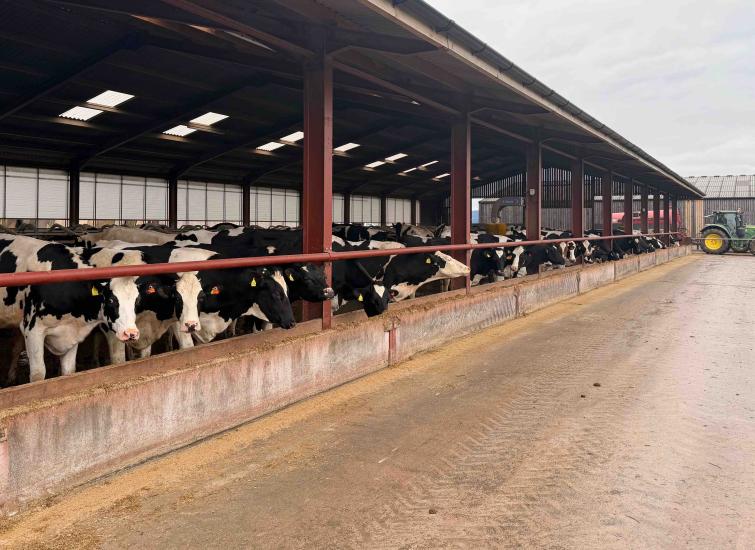
Ben Gibbons farms alongside his father Andy, sister Meg and partner Alex at Catteralls Farm in Lancashire. The family have been farming for over three generations, originally based in nearby Pilling. Since then, they’ve expanded from 140 acres and 100 cows, to now managing 121ha (300 acres) and a herd of 390 Holstein cows. Catteralls Farm operates a flying herd and calves all year round - it’s a high-input, high-output enterprise, suppling their milk to Sainsburys. Replacement heifers are bought in year-round.
For the past six years, the family has worked closely with Ruminant Nutritionist Emma Wells, who now works for Advanced Ruminant Nutrition (ARN). In that time the herd has gone from strength to strength, with yields increasing from an average of 32-33 litres in 2020 to 37 litres in 2024 on twice a day milking. The collaboration between Emma the Gibbons family has focused on improving efficiency and margin, while also driving yield, culminating in an average yield per cow of 39 litres throughout the summer of 2025. In particular, Emma has helped the team at Catteralls shift from using retrospective costings data to a live, real-time “on the day costings” system bespoke to the company.
Improvements across 12 months
|
|
12 month improvement |
|
Milk yield |
+5 litres |
|
Average 305 day production |
+750 litres |
|
Feed rate |
-0.15Kg |
|
Feed cost |
3ppl |
|
MOAF |
+4.75ppl |
“This has made a real difference,” says Ben. “Having access to live data means we can make more informed decisions in the moment, rather than reacting after the fact. It allows us to clearly see how changes impact our costs and ultimately the performance of the whole business.”
The Gibbons family place a strong emphasis on forage, and maximise the land available for homegrown feed. They produce both grass and maize silage, alongside wheat (both crimped and rolled) and barley for use in the dairy enterprise. Alongside Emma and the team at ARN, they’re focused on maximising milk from forage, this has been an area that showed room for improvement in previous years, primarily due to restricted forage stocks as the milking herd expanded.
“Forage quality can often be inconsistent, and with limited land availability, we sometimes face shortfalls,” explains Ben. “That’s why balancing the diet for rumen health is crucial. Even small tweaks can deliver big results.”
Following a forage audit in late 2024, Emma suggested the introduction of an approach to the base ration to help avoid too big a gap in forage stocks throughout the winter months. This helped alleviate the pressure on silage quantities, whilst protecting rumen health by supporting effective fibre levels in the diet. This approach has now become a staple in the base ration for this reason.
Additional improvements were made by changing the formulation of the concentrate fed in the parlour.
Emma says, “In May 2025, we transitioned the milking cows onto a higher quality parlour nut that was carefully balanced with the base ration,” explains Emma. The team quickly saw improvements across the board. The bespoke formulation supported better rumen health in all stages of lactation, which led to fresh cows achieving higher peak yields, and late lactation cows gaining lactational persistency.
The introduction of ARN’s “on the day costings”, alongside a consistent focus on maximising margins and efficiency, has allowed progress of the herd to be tracked in real time as these changes have been made. Over the last twelve months, average 305 day production has increased by 750 litres per cow, feed rate per litre has reduced by 0.15kg, total feed cost has reduced by 3ppl and most importantly, margin over all feed has increased by 4.75ppl.
In early 2025, the Gibbons family started noticing an increasing prevalence of metabolic challenges in fresh cows. Working alongside Lora Fryars from Lanes Vets, the team introduced routine blood profiling to better understand the metabolic status of cows in the lead up to and after calving, to fine tune the nutritional strategy in that period. In conjunction with this, routine body condition scoring across the herd was also introduced. A percentage of late lactation cows were becoming over-conditioned, which was believed to be a significant contributing factor to the issues around the transition period. This was confirmed by the results of the blood profiling, which showed elevated levels of non-esterified fatty acids (NEFAs) and beta-hydroxy butyrates (BHBs), suggesting cows were mobilising too much body condition in early lactation.
Using the insights gained from the blood results and body condition scoring, a dual-phase approach was put in place with a short-term strategy aiming to alleviate some of the challenges posed by higher body condition scores at calving, and a longer-term strategy to prevent weight gain in late lactation.
Rumen protected choline was introduced as a short-term approach to aid fat metabolism in the liver, an area of key concern when cows are carrying excess condition. The immediate aim was to support liver function and allow for a smoother transition, and in turn a more productive start to lactation. “Choline isn’t a long-term fix, but it’s a very valuable tool to support cows through a challenging period,” explains Emma. “The goal remains to optimise both late lactation and dry cow management, so we don’t need interventions like this long term.”
To address body condition in late lactation, Emma also rebalanced the feed tables for the parlour concentrates. “All cows are fed in the parlour using a series of targeted feed tables for stage of lactation and yield,” explains Ben. “We decided to add an additional feed table for cows heading into late lactation that further reduced their concentrate allocation. We achieved this by implementing a lower feed rate per litre as days in milk increased and yield naturally started to decline.”
Since making these changes, the team has seen marked improvements in transition performance, with cows coming into early lactation with significantly fewer metabolic issues. Body condition in late lactation is continually improving, with higher peak yields across the herd since the introduction of the choline. Interpreting the farm data, balancing the PMR and adjusting the parlour feed tables accordingly, has reduced daily feed usage by approximately 200kg per day and despite a significant reduction in feed allocation to late lactation cows through the parlour, lactational persistency has been unaffected. Routine blood profiling and body condition scoring continue to track transition management and ensure changes can be implemented proactively if necessary.
The family are always looking at new opportunities to further their business. They hope the near future holds a new parlour and milking cow sheds, alongside an upgrade for the existing dry cow housing.
Ben, “We have been averaging 39 litres for the past 4 months, but we are constantly looking at making improvements. We are always looking for that sweet spot to drive extra milk. Together with Emma we are really targeting transition management to ensure every cow gets the best start to her lactation, driving the performance of the entire herd.”
〈 BACK